Thursday, November 26, 2015

Rome travel threats

Dear Wilson,

Today I received an e-mail from a dear old friend who asked the questions many Americans are asking -- is it safe to travel in Rome?

The sad truth is, there are some very real dangers every American must be vigilant about in the Eternal City. I don't want to name my friend here without her permission, but here is what I shared with her:

Street Signs
I think the biggest danger in Rome is trying to find your way around. The tourist maps have tiny print that will make you near sighted or blind. The street signs are on the buildings -- if you are lucky. Oh, occasionally you actually see a street sign on a pole. I should probably shoot a photo of that to prove they really exist.
Gelato
And the Gelato! Now there is some really risky business. It is sooooooooo good. And so many flavors. I don't want to get even close to a scale. My instant addiction posed a risk when I went out looking for some last night. It was rainy and dark and I learned that after 10 p.m. most of the Gelato stores are shut up tight. I could have gotten lost trying to get my gelato fix! I finally found one that was open, but it was of lesser quality and I suffered tremendous disappointment; but that didn't stop me from ordering some and wishing I had gotten more of the lemon flavor.
Downpour
Oh, and you have to worry about stepping in dog droppings. And when the starlings gather in the evening, there is a real danger of being under them when they are flying low and the droppings don't have time to dissipate in the air. So, yes, Rome can be a dangerous place.
Terrorists
As for terrorists, they are going to go after dense crowds. Avoid them. Let's face it, we just aren't important enough to be singled out. Unless we are packing several containers of gelato. Then we are a high value target.
Pickpockets
If I were to make any suggestions that would be relevant it would be to have a strategy to avoid pickpockets, because I think that (except for  getting lost) that is the most realistic risk, particularly in crowded markets. I wore my fly-fishing vest, with all its pockets, inside my light jacket. No pickpocket is going to get to my passport or wallet without getting to know me really well. 

Backpacks can be rifled through when they are on your back, but you can shift them around and wear them in front -- it's a little awkward, but you can see if someone tries to get to your stuff. Another risk all travelers run -- getting disoriented and putting something down and forgetting to pick it back up; develop good habits for those times when a lot is happening and you can get distracted. 

Last night I was missing a wallet and I looked in my backpack and coat pockets and my fishing vest, and I couldn't find it. It had credit cards, a debit card, driver's license and more than 200 Euros in it. I began to feel really upset until I found out it was in the pocket of the pants I was wearing. Doh!

 Abundance

Well, this advice is as valuable as the price she paid to receive it. As for you, Wilson, and all my readers, I wish you a happy Thanksgiving Day. And if you are in a place where you can do it, package some leftovers for some street people. You cannot imagine how much they will be touched by that kind gesture. We have such abundance; they have so little.

Love,
Robert

Tuesday, November 24, 2015

Rome refugee center raided

Dear Wilson,

As I said in my last dispatch the Baobab refugee center was raided early today, Nov. 24, and several refugees were detained by Italian police. This happened just five days after the One World Futbol made its debut at the center. I flew into Rome Nov. 15 with four in my luggage and plans to bring more to Baobab. Shortly after I arrived, 20 more balls arrived as I proceeded to identify organizations that might serve as receiving agencies for your cousins.

This morning I found my way by navigating Rome's somewhat confusing street system to one such agency, the Joel Nafuma Refugee Center, a day center which is located in the basement of  an Episcopal Church called, quaintly, "St. Paul’s Within the Walls." The phrase "within the walls" means the church is within the old walls which once formed a perimeter around Rome.

I descended a staircase to a basement refugee center, where young men, apparently African, were playing Foosball,  getting outfitted with clothing, and taking some basic computing classes. A janitor directed me to an office, where I explained to a young man the story of the One World Futbol. He connected me with a Minnesota transplant, Daniela Morales, who explained she came to Rome by way of marriage to an Italian gentleman who was working for the United Nations in New York while she was working there in AIDS-related service.

It was Daniela who told me that Baobab had been raided.

Here's a text of a news article I managed to pull off the Web later in the day:

Rome police detain 23 refugees from Centro Baobab.

Rome police detained 23 undocumented refugees following a dawn raid at the volunteer-run Centro Baobab, which offers assistance to hundreds of refugees every day, on 24 November.

Dressed in riot gear and accompanied by sniffer dogs, around 60 police stormed the well-known migrant centre on Via Cupa, near Tiburtina station, at 06.30. Officers separated those with valid documents from those without – according to witnesses – detaining at least 23 north African refugees at an immigration office on nearby Via Teofilo Patini.


The raid was part of tough new anti-terrorism measures announced by Rome police chief Nicolò D’Angelo in the wake of the recent Paris attacks, and ahead of the Vatican’s Holy Jubilee of Mercy, which begins on 8 December.

Designed to house around 200 people, the Centro Baobab offers daily meals to as many as 700, acting as a refuge to both Christian and Muslim immigrants from the Middle East and Africa.

Volunteers say the raid has renewed their concerns over “rumours of imminent eviction.” 
Daniela and I couldn't do much about Baobab this morning, but I had toted a single One World Futbol to the Joel Nafuma Refugee Center (JNRC) and she gathered a group of refugees and some volunteers, and we headed out to give them a chance to test it out. The ball was a hit. Because of the language barrier, it was hard to explain that it can be punctured without deflating, but they eventually got the message. After they scrimmaged for a while, we took a group photo of the players, some of whom were pretty agile. Readers can click on the photo, which  links to a video you can watch to see how they performed.

One of the highligts of the day was meeting Sarah, the wife of a U.S. Diplomat. Another was getting the address of another agency that connects with several refugee resources. I come home Dec. 1, but before then I hope to establish some connections so that we can distribute more One World Futbols to Rome. I should add that, by virtue of accepting a One World Futbol for the JNRC and introducing it to the refugees, Daniela has automatically become the newest member of Team Wilson. Her cheerful enthusiasm was very encouraging for a guy who showed up at her door without an invitation.

North African refugees get introduced to a One World Futbol. Behind me to my right is Mariah, a JNRC volunteer who joined in a game at a park near the JNRC center. Behind and to my left is Daniela, and behind her, an Irish bloke by the name of George. Sorry, I couldn't spell the names of the rest of our group -- it's a language thing.


By the way, I received an e-mail from Emily Hopcian,  who is involved in marketing for the One World Play Project and has been a wonderful supporter for Team Wilson. Here's what she said:

If the organization you're visiting with is interested in receiving more One World Futbols for the refugees they're serving, please let me know. Our team is looking to launch a campaign to support refugees who are re-settling in Europe.
Isn't that sweet? I've only got a week before I come home. Hope I can make some inroads before I leave.

Love,
Robert

Cucina of Babel

NOTE: As I was preparing to publish the following, we received word that the Baobab refugee center has been raided by Italian police. People were taken into police custody for interrogation. So far it seems too early to explain why this happened. I will try to obtain reliable information and share it as soon as possible. -- Robert

Dear Wilson,

There were at least four languages being spoken in the kitchen of the Baobab refugee center of Rome Nov. 19.

Let's see. French, Italian, Amharic (Ethiopian), English, Arabic...make that five.

And there were probably other languages or dialects in the alley, where families, including toddlers, anticipated their evening meal. The occasion was Ann Anagnost's University of Washington students preparing dinner for well more than 80 refugees, mostly African, I believe. Sorry about my lack of clarity. It was us and the refugees, along with some young Italian volunteers who were there to help, and clearly communicating and understanding what I was observing was a bit of a challenge.

The UW students were preparing a green salad and crafting a version of Ethiopian lasagne from scratch. (If the term "Ethiopian lasagne" makes you wonder, you have to remember that Mussolini thought Ethipoia would be a fun country to conquer, so Italy developed a presence in Ethiopia, making Italy a natural destination for Ehiopians to flee to two generations later.)

Outside, in the alley, toddlers and young adult men were playing with a few of your cousins. I tagged along for the event, bringing three One World Futbols with me. Shortly after we arrived, I took one into the alley, stabbed it with a knife to demonstrate its resilience, and then left it with the individuals who were milling around in the alley or sitting on the few chairs that were left there.

Bundled up against the chill of a November evening in Rome, adult refugees and a toddler play with a One World Futbol in the alley by the Baobab refugee center. More than 80 refugees were awaiting a dinner of Ethiopian lasagne being prepared by University of Washington anthropology students. Photo taken by Flip video camera.


Over the course of the afternoon the ball became grimier and grimier. A couple times it rolled down the alley into the street and had to be retrieved from traffic. One time a hefty kick put it over the wall and a refugee asked a man in the adjoining lot to move his truck so we could get it back.


The futbol continued to entertain well into the evening, when darkness had fallen and overhead lights illuminated only part of the alley.


Inside, the students worked on the meal.

University of Washington Cultural Anthropology Professor Ann Anagnost surveys the makings for salad, some of which she carted to Baobab in her carry-on flight luggage.


The salad assembly line. All but two of the visiting University of Washington students were women. They are in Rome fall quarter for Professor Anagnost's class on the anthropology of food.


Language barriers didn't prevent the refugees from helping out in the kitchen. On the far right is Meraf,  a Seattle-born UW student whose mother, a generation ago, had been an Ethiopian refugee. Meraf has learned, Amharic, one of the Ethiopian languages and could communicate with some of the refugees from his ancestral homeland.


"It takes a village" -- to make good Ethiopian lasagne.


Now it's ready. The students cut portions for more than 80 servings. In 20 minutes it will all be gone. Only a few of the UW students even got a taste. It was all for the refugees.


Mohamad Sanoug, a Moroccan, was one of the first to be served. Moments later he was no longer eating alone.


As the refugees dined and students cleaned up, Ann spoke with Paula, an Italian volunteer, to learn about possible ways to convey more One World Futbols to the center. There is more than one organization supporting the work at Baobab refugee center, and volunteers kept dropping in to play some role.

 More Baobab snapshots:


A banner attached to the outside wall of the Baobab refugee center in Rome


A wall hanging at the Baobab refugee center in Rome.


A mural in the alley behind the Baobab refugee center in Rome


"Refugees welcome," is the title for this gaffiti on a wall in the alley at the Baobab refugee center in Rome.


Here's a link to a video of a One World Futbol in use at the Baobob refugee center:
 https://www.youtube.com/watch?v=F5fNeiYjn8I&authuser=0

 Love,
Robert


Friday, November 20, 2015

A god forsaken place called Mae Sot

Dear Wilson,

At this writing, three of your cousins are temporary residents of Ashland, Oregon, home of the World  Famous Shakespearean festival, awaiting transit to a god-forsaken landscape on the far side of the Pacific that a group of Burmese refugees call home.

Their home is a garbage dump.

The futbols should have been there by now, but there's a holdup. This is the story of how this came to be, along with a compelling example of charity, love and perserverence.

It was Donna Boehm who first told me about Mae Sot, and about Fred Stockwell, a photographer who got sidetracked on his plan to retire to Thailand. His retirement is now a full-time career in a refuse dump, which is both a settlement and workplace for Burmese refugees. Fred was visiting from Mae Sot to attend a fund raiser at the Dana Campbell Vineyard in Ashland, she explained, and the school at Mae Sot could probably use some One World Futbols.

Maybe I should explain who Donna is. I met her online some time ago on one of those dating sites. After you've done this for a while, you learn how to evaluate people from their photos, and Donna turned out to be the real thing -- gentle, bright, cheerful and socially well adapted, with an emphasis on the last quality. Until recently, Donna lived in Talent Oregon, right next to Ashland where the Shakespearean festival is held. Her avocation was being the wardrobe goddess for local theaters.

Wardrobe goddess Donna Boehm with some greeting cards.


Along the way, Donna developed a modest business selling greeting cards she fashioned using fabric from costumes that were created for the plays. She made one for me, similar to the "jacket" card in the photo above.


Anyway, Fred Stockwell had lived in Ashland, and he was coming back for a visit and the fund raiser. He is a hero to a local charity, Eyes to Burma, which has supported Fred's efforts for seven years. You can find its page on Facebook.

The benefit and celebration, set for Sept. 27, also marked the kickoff for a global fundraising campaign  in coordination with ETB's supporters from around the world. I found it pretty impressive that a group in Oregon had worldwide support.

Donna, who knew about the Wilson campaign to raise One World Futbols for impoverished communities, thought that, if anyone could use indestructible futbols, it would be the young people of Mae Sot.

Fred arrived in Ashland. The fund raiser,  occurred. I ordered the futbols from One World Play Project and shipped three off to Kara Lewis, an Ashland-area resident who had actually visited the Mae Sot community. The balls arrived on time and Fred flew back to Thailand -- but without the balls! The fund raiser had been too successful, and donated computers had displaced the balls in Fred's limited luggage space.

But all is not lost, as Kara explained in a Nov. 7 e-mail. She says,


My boyfriend recently shipped a light-weight box to a friend in Thailand and it was $20 for a long shipping plan and $60 for arrival within a week. I'm planning to do the less expensive option. So, the balls are still on their way, just delayed longer than originally planned.

Saya Joe, our head teacher, is really good about taking photos on his phone and sending them to me on Facebook, so when the balls arrive he can take images for us, which I will for sure share with you as well as any details about their use. With the computer donations, I received photos of their use and news about students who were using them. The donors really appreciated seeing and hearing about the students their laptops went to. I want to do the same for you.

Students with computers at the school at Mae Sot


I'm hoping the delay with the balls being sent is a blessing in disguise. When Fred went back, it was still the rainy season, with some flooding. Then when I talked to him three days ago, they were in the middle of a heat wave and dehydration was an issue. Hopefully, when the balls arrive it'll be ideal playing weather.

Just so you readers understand the environment these three balls will arrive at, I'm posting below excerpts and photos from Eyes to Burma's Facebook page. They present a truly touching sense of the plight millions face, as well as the resilience of the human spirit.

The mission of Eyes to Burma is "assisting the vibrant community of Burmese migrant workers and economic refugees who live and work at and around a rubbish dump in Mae Sot, Thailand." As stated on their Facebook page,

ETB's founding belief is that water, food, health, shelter, safety, and education are human rights.

Our volunteers, teachers and translators work hard to help this community acquire these basics when they do not have access to them or when their incomes fall short. ETB projects provide a safety net so individuals and families can work to improve their own lives and also to help each other. The philosophy behind what we do is to give a hand up, not hand-outs; to offer access and tools that people need to do things for themselves.

Foreign, domestic supporters

Aussie Friends of Eyes to Burma and supporters in Canada and the US are working on fundraising campaigns and grant applications to raise money for student sponsorship in 2016 so ETB can help more students from the community attend Children's Development Centre - CDC. Currently ETB assists 20 students and some of their families in order for the students to attend the nearby migrant learning center while still living at home. Helping keep families together is a vital part of ETB.

Gloves, masks, glowing toothbrushes, a toilet!

Today we walked around the rubbish dump giving every family Gloves, Face Masks and Toothbrushes. The children received toothbrushes that light up when they clean their teeth. Everyone was very happy with the gloves and at first they didn't wear the masks but after a while we found more & more people wearing them. Tomorrow night we have the Buddhist Monks coming to the new land so everyone can pay their respect to the Monks and make offering to the Monks.

 Some big news, we will soon be building a toilet on the new land. This will be the first of it's kind and is sponsored by the people from Australia. The new land we now have has been named Buddha Land.

Grannie's House

Fred took two community members to select wood for a house being built on ETB's new land for a grandmother and her three grandchildren in need. ETB provides the funds for the materials and the labor.

Grannie's "house"

 We are adding new buildings to Buddha Land, the property we rent next to but off the garbage dump. There are already 12 families living there in a safe, family-friendly environment. ETB asks everyone who lives there to look after the land and each other as well as make decisions about its growth.


Children's Development Centre


In the morning, we helped re-enroll 11 students into Children’s Development Centre (CDC), a migrant learning center run by Mae Tao Clinic that is close to the dump and provides primary and secondary level education to Burmese migrant children.

 Getting clean water

At the start of the evening, Fred did Day four of delivering water to a part of  the community that has been cut off from access to clean water.  This situation could have been a major crisis,  but Fred had a plan in action immediately.

Fred Stockwell delivers clean drinking water

 At the end of April, garbage trucks dumped trash in front of one of ETB's water tanks over multiple days, so Fred devised a direct delivery system with people filling their water jugs from the tank on his truck.  A week later, the garbage continued getting dumped onto the road in front of the houses  and then spread onto the road leading to the whole neighborhood,  making it impassible by truck and extremely difficult for community members  to carry their water jugs over it.

 The large machine which scoops the garbage onto the landfill  was broken and couldn't move the trash. 

What do you think, Wilson? Is Mae Sot a proper destination for the One World Futbol? There likely will be more to share about Mae Sot when your kin arrive.  In my next letter, I'll tell you about cooking for refugees in Rome.

Love,

Robert

Home sweet home: The Mae Sot refuse dump.

Tuesday, November 17, 2015

Roma!

Dear Wilson, 
It was only after we had made it across theTiber that I got the first whiff of urine. "Do people really pee right here on the bridge right in the heart of Rome, and in broad daylight?" I wondered. You see evidence of that occasionally in Seattle, but not to this degree. 

Then Ann explained that it was the starlings.
 
Above the Tiber River, thousands upon thousands of starlings swarm prior to their winter migration.

Ah, the starlings. The United States has only had a taste of this avian pestilence. But in Rome at this time of year uncounted hordes of them gather and disperse, swoop and rise like the fluids in a lava lamp. The clouds of starlings clump, merge and dissolve, flowing back and forth across the Tiber as children watch wide-eyed, point, chatter and laugh. The murmurations of the starlings grab your attention visually and audibly.Trees are thick with them, issuing the rustling sound of an endless waterfall. And as they swarm this time of year -- as they must have since the times of the Caesars, they scent the air with their downpour prior to their winter departure across the Roman Empire's sea of "middle earth"-- the Mediterranean-- for Africa.
 
Why settle for just urine, when you can have it all-- which is what the starlings left on this whitewashed auto.

Why Rome?

I am in Rome to keep a promise. It is time to distribute the balls that Team Wilson raised this past year, and there is no greater need than for the armies of refugees, fleeing drought and war for safe haven in Europe. Many have tempted--and even confronted--death, leaving everything they have behind. They could use an opportunity to simply play.
 

I have arranged with One World Fubol Project to ship 20 balls to the Rome Center, where my friend, Ann Anagnost, is staying while she teaches a food anthropology course to visiting University of Washington students during their fall quarter. The balls will be shipped from a distribution point in Germany. The donors -- readers of the Wilson Chronicles-- will, I hope, get a first-hand view of how their kindness is shared and received. (And this news just in at 10 p.m. Tuesday evening --the futbols have arrived! We will pick them up in the morning.)

A lingering question, of course, is whether Europe will continue to serve as a safe haven, or turn hostile toward refugees as a result of the recent terrorist attacks in Paris. With that in mind, there is irony in how I arrived here. On the heels of the bloodshed in Paris, I flew from Seattle to Amsterdam and then to Rome. In Amsterdam's airport, I merged with a thick clutch of fellow travelers, inching ahead like so many squirming spermatoza swimming toward the promised land. Well, OK, we were really just trying to make our connecting flights.


What security checks?

On a more magnum scale, I wanted to make mooing noises as we pressed forward, but thought better of it. Under the circumstances, my fellow amblers might not have shared my sense of humor, or metaphor. Finally I reached the security checkpoint. An official young enough to be my son looked at my passport, asked me why I was going to Rome, and waved me through. It took all of 30 seconds.
 

In Rome I deplaned, rolled my carry-on to the baggage carousel, and exited baggage claim to join the tall white-haired lady with the large sunglasses who awaited me. There was no customs check. No looking into my carry-on. No encounter with a human being. Maybe they X-rayed my checked baggage someplace between Seattle and Rome, but you couldn't prove it by me. In the European Union, it's still like going from Washington to Oregon. All right. Of course, returning home will not be that efficient. But where was there even a hint of security when I arrived here? There must be  something I'm not understanding...
 

It's been a while since I've written, Wilson. 

Quite a while. 

It must be lonely up there on Mount Adams. At this time of year, you don't get a lot of company because of the weather. Fortunately, being unbreakable, you're ready for the wind and the chill. But there is much to share about the gifting of the futbols. And I'll start in the next dispatch with the story of a garbage dump that is home for a community of refugees in a place called Mae Sot. Until then...


Love,
Robert
 

Wednesday, August 26, 2015

Yi people and the One World Futbol

Dear Wilson

Imagine a village with children who have never seen a soccer ball.

This was the case earlier this month until Huang Yu arrived in Sichuan Province, China. Yu is an anthropologist who has been teaching at the Chinese University of Hong Kong. I introduced you to her in my letter of July 28, just before leaving Hong Kong. You may recall part of her research involved studying the loss of biodiversity in Chinese food crops because the use of commercial seed is leading farmers to stop saving seed.

Futbols almost confiscated

Yu took a couple One World Futbols with her when she entered China, knowing that she would be in communities where the people are very poor.

But that almost didn't happen. When Yu tried to take the balls aboard a plane in Kunming in Southwest China, they were almost confiscated. As she explains it, "the security people wanted to deflate the balls and couldn't. They were afraid that the balls would explode under the high pressure on the plane. I argued with them and eventually could keep the balls."

What a great story! Yu, who is not only an honorary member of Team Wilson because of her help; now she is a Team Wilson pioneer, for introducing these balls in a part of the world where they are so unknown that they worry airport security. Team Wilson has broken ground in the world's most populous country.

Here's what she did afterward, as explained in an e-mail:

Professor Huang Yu

Dear Robert, 

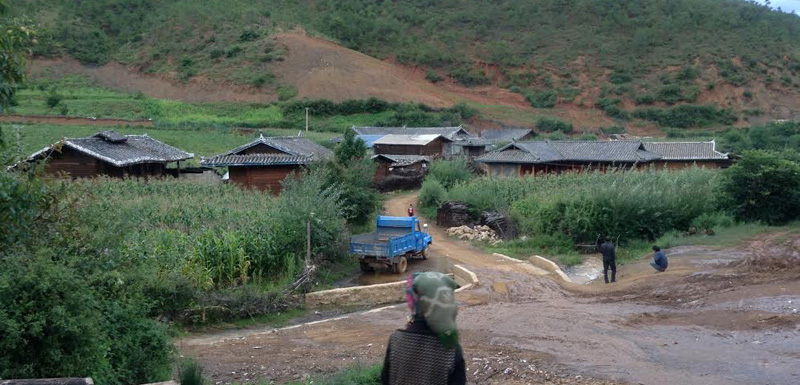
I gave one futbol to a village located in Luguhu Town, Yanyuan County, Sichuan Province. The county lies in a high-altitude basin (2400-2500m elevation). The children belong to the Yi ethnic minority group. The villagers there grow buckwheat, corn, potatoes, and sunflower for family consumption. 

Yi village at Luguhu Town. Photo by Huang Yu


They also sell the extra produce to the market. Some of the children are called “left-behind children” whose parents go to coastal cities and do factory or service work. The village is adjacent to the famous tourist site Lugu Lake. In the summer, children often walk 2-3 hours to Lugu Lake to sell sunflower seeds and souvenirs. There is no sports facility in the village. I donated the ball to children and they were very happy. 

I gave another futbol to a village located in Mianya Town, Yanyuan County, Xichang City, Sichuan Province. The village is also dwelled by the Yi ethnic minority group. They used to live in the mountains and moved to the current basin area about 5 years ago to get their children better schooling opportunities. 

The current village used to be an apple plantation, but the owner abandoned it a few years ago due to the decline of profit. He sold some areas of land to his former employees, many of whom are the Yi people. Now the village is very poor without drinking water and electricity. Most families grow buckwheat for their own consumption and also raise sheep for cash. The adults either go outside as migrant workers or get day labor in the adjacent walnut plantation. 

There is no sports facility in the village and the children’s activities include catching wild birds and collecting wild mushroom. I gave the futbol to the village head and he promised that he would let children play the ball often. A lot of children have never seen a real futball before and they were really excited to have the chance to play it.
best,
Huang Yu


At least some of these Yi farm children had never seen a soccer ball. Photo by Huang Yu

I had to read Yu’s e-mails a few times to absorb everything she said. Then I looked up some information. 

The Yi People

Here’s what Wikipedia says about the Yi ethnic group:

There are an estimated 8 million Yi people in Thailand, Vietnam and China, where they represent the seventh largest of the 55 ethnic minority groups officially recognized by the People’s Republic of China. In China, they live primarily in rural areas, usually in mountainous regions. Most are farmers, herders of cattle, sheep and goats. They speak “mutually unintelligible” languages.

Buckwheat. Photo by Huang Yu, Inset from Wikipedia.

Buckwheat

And here’s what I found out about buckwheat:

You know, never once in my 70 years did I ever wonder what buckwheat was. I just assumed it was one of three things: something related to afalfa; a character from a Little Rascals movie that would be politically incorrect nowadays; or the same character, satirically recreated by Eddie Murphy on Saturday Night Live.

Well, it’s none of those. Buckwheat isn’t wheat. It isn’t even a grass. It’s actually related to rhubarb, knotweed and sorrel. It’s referred to as a pseudocereal, similar to amarynth, whose seeds are eaten like grain. Its production declined in the 20th Century with the introduction of nitrogen fertilizer used for other staples, but it has been cultivated for probably 8,000 years, first in Southeast Asia. 

Wikipedia states that it has been in Finland as early as 5,400 BCE. Buckwheat handles elevation well, and has been  grown on the Tibetan Plateau.

Just think. Someday those children of buckwheat farmers who lack electricity and safe drinking water will see a "real" soccer ball and they will think it's just a cheap imitation, because Yu brought them unbreakable soccer balls that won’t wear out and go flat.

Love,
Robert


Wednesday, August 12, 2015

Futbols to Zambia

Hey Wilson,

Would you believe that, because of you, there are 13 one World Futbols being kicked around in Lusaka, the capital city of Zambia?

In Lusaka, the capital of Zambia, a Seattle Academy student introduces African youngsters to the wonders of the One World Futbol. Last March, publicity about Wilson's Madison Street Marathon inspired the students to raise money for the balls and take them  to Africa as part of their summer program.

Outcome of the Madison Street Marathon

Those balls are in Africa because of the Madison Street Marathon that featured you and your relatives last March. Remember the marathon? (If not, click here for the story.) We were going to hold it on the Ides of March, but rain persuaded Team Wilson to shift to St. Patrick's day, and the 27-mile march up and down Seattle's Madison Street Hill got coverage in the Capitol Hill Times. That coverage, and the fact that we were lugging eight of your relatives back and forth past the Seattle Academy of Arts and Sciences got the school's attention. When they found out about how resilient you were, the students got inspired. They decided to take One World Futbols to Zambia as part of the Academy's summer service program and they raised funds to purchase the futbols.

Seattle Academy seniors  Jessica Whetzell, Deanna Faour, and Ian Zunt, with the One World Futbols the school raised. Yes, it's true -- they aren't all blue.


Traveling to Zambia is no small feat. The flight can take between 24 and 30 hours -- the 30-hour flight goes through Dallas, Paris and Nairobi to reach Lusaka, according to Melinda Meuller, the faculty member who hosted us at the school for our show-and-tell after our marathon. The fact that academy students go to Zambia every summer means they are well aware of how difficult it is in distressed communities to maintain a standard ball of the world's most popular sport, and how useful your type of ball truly is.

Futbols and computer labs

Melinda explained that the students spend three weeks living and working at Lusaka, operating out of a lodge owned by a man who sponsors a boys soccer team. Two of the futbols went to that team.

"The goals of our Zambia Program are to support our Zambia partners in their educational missions, and to give our students an opportunity to live and work in communities outside the USA, in support of those communities' goals," she explained. She added that--


Adademy students work at several schools in Lusaka:
  • At Munali Boys Secondary school, Munali Girls Secondary School, and Munali's "Special School" for Deaf students, we mostly assist with computer training. Seattle Academy, in partnership with Zambia Pacific Trust, helped these schools outfit computer labs (starting in 2001). The schools now have full-time computer teachers, so our visits are now focused on cultural exchange, as well as supplementing the schools' equipment with new laptops. We donated four futbols to the Munali schools.
  • At Birdland School (a private primary school, with a mission to include among its student body vulnerable children, such as those orphaned by AIDS) we also support their computer program, but also their library (which Seattle Academy helped to build), and their new science program (Seattle Academy 6th grade science students put together science kits each year, which we take to Birdland). We donated the rest of our futbols to Birdland.

Playing soccer at Birdland school, whose mission is to include among its student body vulnerable children, such as those orphaned by AIDS. 

By the way, the students had planned to donate 20 balls, but Melinda reported that American Airlines lost a bag that contained seven. They have filed a lost bag claim, and plan to re-purchase the lost futbols.

Well, this letter has been about the balls that were raised and donated by the Academy students. In a couple months I hope to be telling you more about distribution of the futbols that Team Wilson raised. In the meantime, enjoy the view from the top of Mount Adams. It has to be spectacular, with the Perseid meteor shower overhead this week. Wish I was there to see it. It's kind of overcast in Seattle.

Love,

Robert