Wednesday, May 10, 2017

A love story--tears and all


Hello, Wilson.
It's been a while. I've been distracted with life, but we still have about 70 balls yet to give away, and I wanted you to know that I haven't forgotten that obligation.

There's another batch on its way to Zambia this summer. Students at Seattle Academy of Arts and Sciences, pictured with me, above, will be taking up to 20 balls there to deliver to African kids. And if things turn out as planned, I'll be delivering another 20 in the fall. But I want to see how that pans out before I say where that will occur. I hope to surprise you.

Right now, I want to tell you about the Zambia project.

This is the third year I've spoken to Academy students about the One World Futbol, and I was wondering what I would tell them this time. I decided to give them a dose or realism. So I started out talking about the corruptibility of power with a quote most people have heard:


And then I tried pulling up famous examples of power--"The Force," for example. It's a kind of power we've all heard about, and it's everywhere, according to this guy:


And so is gravity. It comes in great and lesser concentrations, but it is everywhere. Even a pencil has a bit of gravity.

Having said that, I dove into our history -- starting with how I decided to climb Mount Adams on my 70th birthday.

Mount Adams in southwest Washington.


 And how a documentary about refugee kids playing with balls made out of rags inspired a couple guys in the music business to create a virtually indestructible ball that got the attention of news personality Katie Couric, who was amazed that her knife couldn't flatten this ball.

A ball of rags; Sting and ball creater Tim Jahnigan, and Couric, with her knife.


Tom Hanks and Wilson's namesake in Castaway.

Naming my mascot

I told them how I  decided to dedicate my training to raising funds for this ball, and that you became my mascot and traveling companion. I also explained that I gave you a name from a famous movie--a name that almost everyone recognized immediately:


I talked about taking you with me to Germany, where I searched for traces of the Third Reich, a prime example of the corruption of power. I shared the story of how I introduced you to Valentine's day and the subject of love. And I pointed out to the students that love also is a power with a special trait --it is unextinguishable.

 The Nazi's tried to smother it; the Khmer Rouge tried to crush it. And it just kept coming back. In all sorts of ways.

Hitler's Dachau and the Pol Pot's killing fields could not extinguish this thing we call love.

What is it?

What is this thing called "love?"

Who knows? I can only provide examples: Catching someone who has lost his balance on a subway is an act of love. Telling someone they forgot their credit card at a counter is an act of love. And giving someone a One World Futbol is an act of love. All these acts are as tiny in love as a pencil is tiny in gravity -- and yet it is there.

I talked about the acts of love just last summer when medical teams fanned out from Seattle to provide health services in Peru, Morocco and Vietnam and delivering One World Futbols.

A volunteer prepares to fluoride a child's teeth; futbols to Thai children living in Vietnam.


Lost!

I told them how devastated I was I had lost you while Climbing Adams--about as bad as Tom Hanks felt, when he lost Wilson at sea.

And then I told them  how strangers had found you along the trail and bore you to the top of the mountain. One donor told me that, after she learned you were found and had made it to the summit of Mount Adams, she got all teary.  Geeze! I thought only Tom Hanks had that kind of power! I got braggin' rights!

Wilson topped a summit that was beyond my reach, and the story gave one donor the sniffles.

Refugees in Rome

And I told them about University of Washington students who joined me at a refugee center in Rome, where I distributed the futbols and they cooked meals and gave the Wilson campaign a theme song: Lean on Me.

At a Rome refugee center in Rome, simple meals were a welcome act of love.

Finally, I shared with them the story of a crippled classmate I encountered at a reunion who remembered I had carried her books 25 years earlier. (I had no recollection of something so ordinary. Why would I?) And I promised them that someday, 50 years from now, long after they had forgotten all about it, there would be an African who would share the story of the young people from Seattle who brought them these marvelous balls. . . The recipients will never see the sponsors who made that gift possible, and that serves as a testament to how far the impact of a kind gesture can reach.

Is there any power that cannot corrupt?

And I left them with a simple question: Does all power corrupt? Isn't it possible that there exists at least one great, magnificent power that doesn't corrupt?

I gave the students five futbols and said if they raised money for 10, I would give them five more. I am confident that they will be taking 20 to Zambia this year.
Love,
Robert,
and Blue


At Seattle Academy, I'm with instructors Gabe Cronin (on my left) and Melinda Mueller, who slips an ice pick into Blue. When the students saw Blue hold up to the ice pick, some eyes widened. They knew they were in for a great story.


Sunday, December 11, 2016

Memories of Viet Nam


This isn't a candid shot -- the cutie was posing.


Hey, Wilson,
If a picture is worth 1,000 words, here are more than 60,000 words which you can speed read, plus a few additional captions and sub-headlines, just in case the picture might need some explaining. By the time you get to the end, you'll know why I plan to go back to Hanoi. It's an affordable destination, the people are friendly, and the country has a rich history and a stunning landscape. And they love the One World Futbol.
Enjoy!

Second night: As quickly as a monsoon flood filled this alley up to the hotel steps, it was gone.


Vietnam is the world's fourth largest rice exporter, behind China, India and Indonesia.

Many of those North Face and Puma articles people purchase are made in Vietnam.


She made that scarf on the loom she is operating.


Flower, my one-legged tour guide, gave me this. She makes the pop-up cards to pad her income.

Hanoi views

A night shot from the May de Ville Hotel, looking out on Hoan Kiem Lake.

Breakfast buffet at the hotel, which charged $50 per night for two and includes a swimming pool.

Front and back view of a bill worth about $5 American.  And yes, that's Ho Chi Minh.

Ho's mausoleum.

The photo above is where Ho's body lies pickled, just as the bodies of Lenin and Stalin were displayed near Moscow's Red Square. He wanted to have his ashes distributed throughout Vietnam, we were told, but the state preferred to display his body, which requires occasional maintenance.

Military men march in the vicinity of Ho's mausoleum.

Monsoon rain pours off awnings and onto the narrow streets of Hanoi.

Hanoi has a women's museum which features heroes of war and matrimony.


This pagoda is famous for perching on a single post.

Inside the one-post pagoda

Outside the one-post pagoda


A strategic bridge of the American war is now a relic.

Hanoi is a city of rivers and lakes, so bridges are critical. This bridge (above) was strategic for moving munitions during the American war, so it was bombed repeatedly. And repeatedly the Vietnamese put it back into operation. Now it is so rickety that it is no longer used.

With the cocktail, the meal costs less than $8 American.

This narrow street is lit with strings of lights at night.

Night: Time to get out on the street and commune with friends, snacking and sitting on tiny stools.

Drummer and dragon dance. The boy hopes money will be thrown into his basket. 

In an urban monastery, he plays ancient tunes on a flute while she drums the bamboo xylophone.

Afterward she shows a tourist how to play the instrument. Bamboo rods provide the tones.

National Day

Sept. 2 is Vietnam's equivalent to the Fourth of July. Some streets are blocked off along Hoan Kiem Lake, and they are filled with families and friends strolling together. If the faces didn't look Asian, you could imagine you were in America.


The mother is trying to photograph her son in front of some flowers.


Everyone wants to be on the bridge over part of Hoan Kiem Lake.


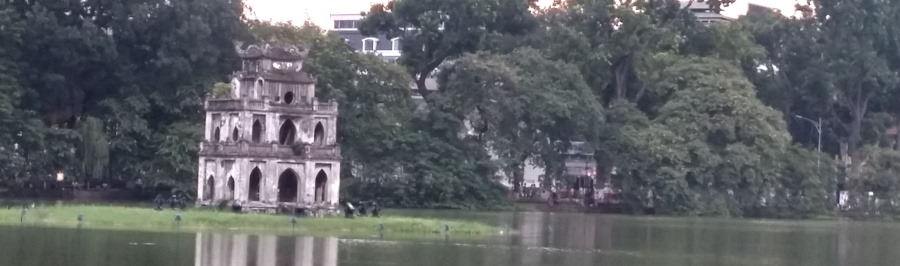
This monastery rests on a small island in Hoan Kiem Lake.


He's playing Red River Valley on that banjo, the instrument African slaves brought to America.


Mai Hich--The first village for our medical mission.

On the floor of a river valley a concrete road takes us past the rice fields into Mai Hitch.


They were cheerful, friendly, and apparently used to foreigners. What do they think as we pass?

Our receiving line as we arrived.

Unloading the tooth brushes and other medical supplies.


Raising the banner for the health clinic, at the community center.


On the village playground, both girls and boys were active participants.


Curious children were eager to meet the strangers.


Our "stadiometer" for measuring height was built of post-it notes held in place by medical tape.

A pre-adolescent works her embroidery as she watches the clinic activities.


Second village -- Cun Pheo

With cell towers, remote villages aren't so remote any more.


Men slept at one end of our loft; women, at the other, protected by mosquito nets.

The home-stay had a fancy schmancy pig sty. with cement columns.

A  vendor rode his cycle to the house, offering food for sale, and--in this photo--fish oil.

On the left, a grapefruit-like plant. The bananas, right, were put out for us on the bottom floor.


Dau Thi Thu, a member of the Buffalo Tours group that supported and facilitated our clinics, introduced Jean Baptiste, my One World (mini) Futbol and traveling companion to a village infant. That  little "Mohawk" topknot seems to be typical for male babies.

In the photo below, a rather large moth, with at least an 8-inch wingspan, sleeps on the frame of the facility where we stayed. There were geckos on the building useful for culling smaller insects, but none of them seemed large enough to seriously consider attacking this enormous creature.


A squat toilet. They don't accommodate paper, hence the wastebasket in the corner.

"Bloody Mary's chewin' betel nut. . ." It stains the teeth black and is slightly addictive, we were told.


It's not hard to figure this out -- it's a chart for forest fire risk, just like the ones stateside.

A meal served up at our going away party.


Our medical team squeezed in a group selfie; our leader, John Phillips, got crunched in the smoosh.

On our last night, there were many rice wine toasts


One of our final views of Cun Pheo -- the lumber mill.

The ancient city of Lau Lu

After the medical missions were over and our team had left the country, I took some time for an excursion to Lau Lu, Vietnam's ancient capital dating to 800 BC. It was situated in what has been referred to as "Ha Long Bay with rice fields." The impressive karst topography of upward thrusting limestone rocks -- which created natural defenses from invasion -- rise from the land instead of the sea. Through these fields flows the Ngo Dong river, and I believe it is on that river that are located the three caves, (or "Tam Coc"), which are plied by women with boats they propel and steer with their feet. How do they do that?


This roof design indicates a facility for a young emperor-to-be, I believe.


I dodged this "obstacle," unaware it was a photo op to sit on the buffalo for a couple of bucks.

If you are going to grow rice, it helps to be somewhere that has lots of water--Lots of water!


Never mind the umbrella -- I have trouble enough rowing with my hands


She makes it look effortless.

Well, Wilson,
I hope you've enjoyed going along with us--vicariously, at least. There will be more stories to tell in my next travels to distribute One World Futbols.

Love,
Robert, and Jean Baptiste